
Views: 0 Author: Site Editor Publish Time: 2026-07-02 Origin: Site
TrailNAV, an open-source solar-powered offline navigation device based on ESP32-C6 MCU and 2.7" e-paper display, was released in June 2026. It integrates NEO-M8N GPS and QMC5883L magnetometer for destination guidance and digital compass — fully off-grid, no cellular required. Fully open-source on GitHub, demonstrating embedded systems' potential for ultra-low-power outdoor navigation. <news from Hackster.io, Jun 2026>
A solar-powered offline navigation device built for outdoor exploration, waypoint tracking, and off-grid adventures.
Story
Modern navigation systems are powerful, but they often depend heavily on smartphones, internet connectivity, and frequent charging. During hiking, trekking, cycling, camping, or emergency situations, these dependencies can become limitations. Phones drain quickly outdoors, screens are difficult to read in sunlight, and power availability becomes uncertain in remote areas.
TrailNAV was created as an attempt to build a simple, reliable, and energy-efficient navigation companion designed specifically for off-grid outdoor use.
Instead of focusing on complex maps or heavy interfaces, TrailNAV focuses on the essentials:
direction
destination guidance
low power operation
readability in sunlight
long endurance
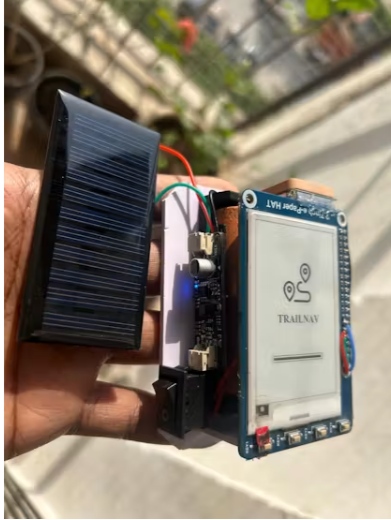
The device combines a sunlight-readable ePaper display, GPS navigation, digital compass sensing, solar charging, and ultra-low-power embedded electronics into a compact handheld form factor.
What makes TrailNAV special is that it was designed and built entirely as a DIY hardware project using simple materials like PVC sunboard sheets and hand-crafted assembly methods, proving that practical outdoor technology can be built with accessible tools and components.
Features
Solar Assisted Charging: A rear-mounted solar panel continuously charges the internal Li-ion battery through an MPPT charging module, extending operating time during outdoor use.
Ultra Low Power ePaper Display: The 2.7-inch Waveshare ePaper display consumes power only during updates, allowing long battery life while remaining perfectly readable in direct sunlight.
GPS Navigation: Using the NEO-M8N GPS module, TrailNAV provides:
destination guidance
directional navigation
heading information
distance estimation
without requiring internet connectivity.
Digital Compass: The integrated QMC5883L magnetometer enables real-time directional heading and compass visualization.
Physical Button Interface: Three tactile buttons allow simple and reliable interaction even while wearing gloves or during motion.
Off-Grid Operation: TrailNAV is designed to work independently of:
cellular networks
cloud services
online maps
continuous charging infrastructure
making it suitable for trekking, cycling, camping, field exploration & emergency navigation
MPPT charge controllers are expensive, but they are the best charge controller technology on the market. In this article, I’ll answer some of the FAQs about these devices. If there are any questions I haven’t answered, please feel free to ask in the comment section.
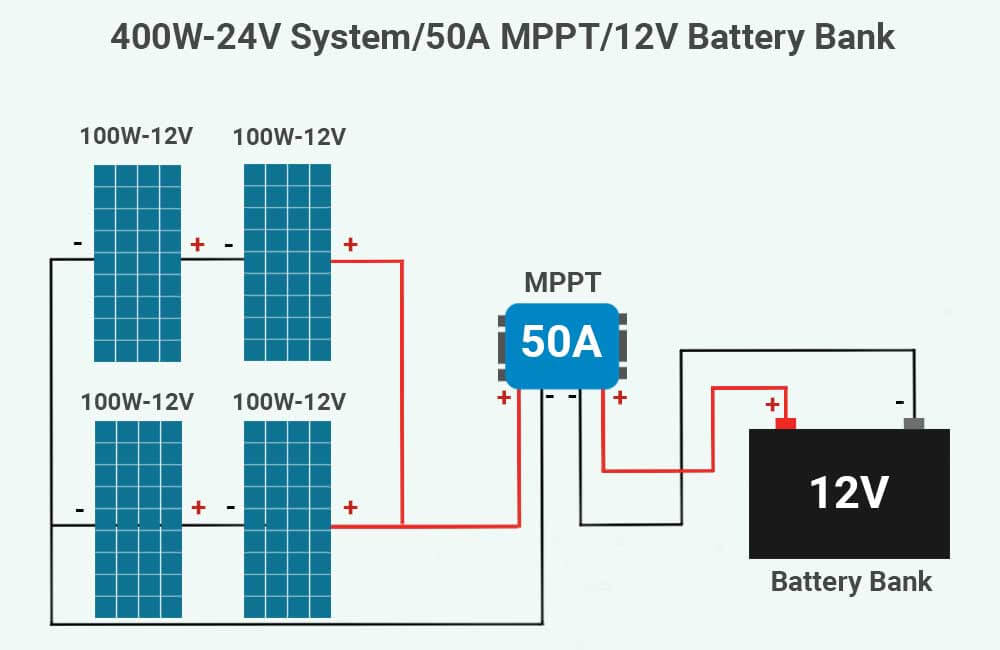
MPPT charge controllers – also called Maximum Power Point Trackers – are efficient DC-DC converters used in solar systems to connect solar panels to batteries and DC loads.
MPPT charge controllers regulate the voltage and the current from the solar array to match the requirements of a charging battery and consequently protect it.
The main advantage of MPPT charge controllers is that while protecting the battery, they manage to optimize the output power of the solar array and minimize energy losses.
These electronic devices are categorized by their Output Current (in Amps) and come in different sizes. The higher the amperage rating on an MPPT charge controller, the more Amps (current) it is able to put out.
They are also limited by their maximum input and output voltages. For example, consider this MPPT charge controller from Victron.
· It has an Amperage rating of 30A: which means it will not put out more than 30 Amps of current.
· It has a Maximum Input Voltage of 100V: meaning that the maximum voltage of the solar array connected to it has to be lower than 100V.
· It is designed to work with 12V and 24V battery banks: which means it will not work with 36V or 48V battery banks.


