

Views: 0 Author: Site Editor Publish Time: 2026-11-02 Origin: Site


Bio-inspired robots are formed by the integration of biological and electromechanical systems at the molecular, cellular and tissue levels. They possess unique advantages such as high energy efficiency, self-growth, self-repair and biocompatibility, and represent a rapidly developing frontier field in recent years. Bio-inspired robots that utilise skeletal muscle as a biological actuator generally face technical bottlenecks, including weak actuator output, limited manoeuvrability and operational constraints imposed by wired control, which severely hinder the practical application of such robots.
Recently, a research team from the Robotics Research Laboratory at the Shenyang Institute of Automation, Chinese Academy of Sciences, inspired by the swimming mechanism of the manta ray, has developed a wireless, near-infrared light-controlled bio-inspired manta ray robot based on isolated skeletal muscle from the bullfrog. This robot demonstrates significant improvements in multiple aspects of its locomotor performance, opening up entirely new technical avenues for the development of a new generation of wireless, controllable, high-performance bio-inspired robots. This achievement was recently published in the international academic journal *Advanced Functional Materials*.
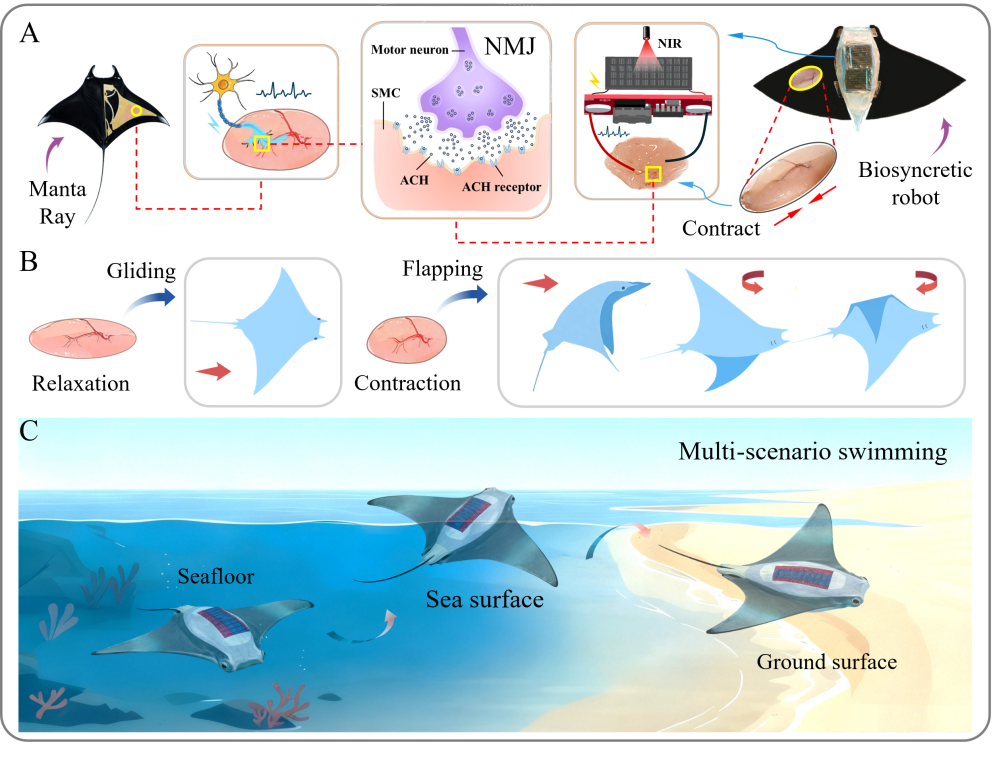
In terms of wireless propulsion, the research team constructed an integrated propulsion architecture comprising ‘near-infrared laser – photoelectric conversion – neural electrical stimulation’. Gallium arsenide (GaAs) photovoltaic modules are integrated onto the robot’s back; by irradiating the left and right photovoltaic modules with laser light in a time-division and zone-division manner, the sequencing of bilateral muscle contractions can be independently controlled. This enables complex multi-degree-of-freedom movements—such as straight-line travel, left and right turns, circular patrols and U-turns—without the need for external cables, thereby achieving precise, cable-free underwater motion control. As this approach does not require genetic modification of biological tissue, it broadens the range of applications for bio-inspired robots in underwater operations.
Performance test results indicate that this bio-inspired manta ray robot has achieved several breakthroughs in terms of manoeuvrability: the average straight-line swimming speed reaches 0.54 body lengths per second (approximately 2.7 centimetres per second), whilst the instantaneous peak swimming speed can reach 2 body lengths per second, setting a new record for the highest relative forward speed achieved by a bio-inspired robot driven by skeletal muscle tissue; the minimum turning radius is just 0.8 times the body length, the maximum turning angular velocity reaches 21°/s, and a complete circular trajectory can be completed in just 17 seconds. The robot also supports surface cruising, underwater operations carrying a 5-gram payload, and low-speed curved movement on hard surfaces.
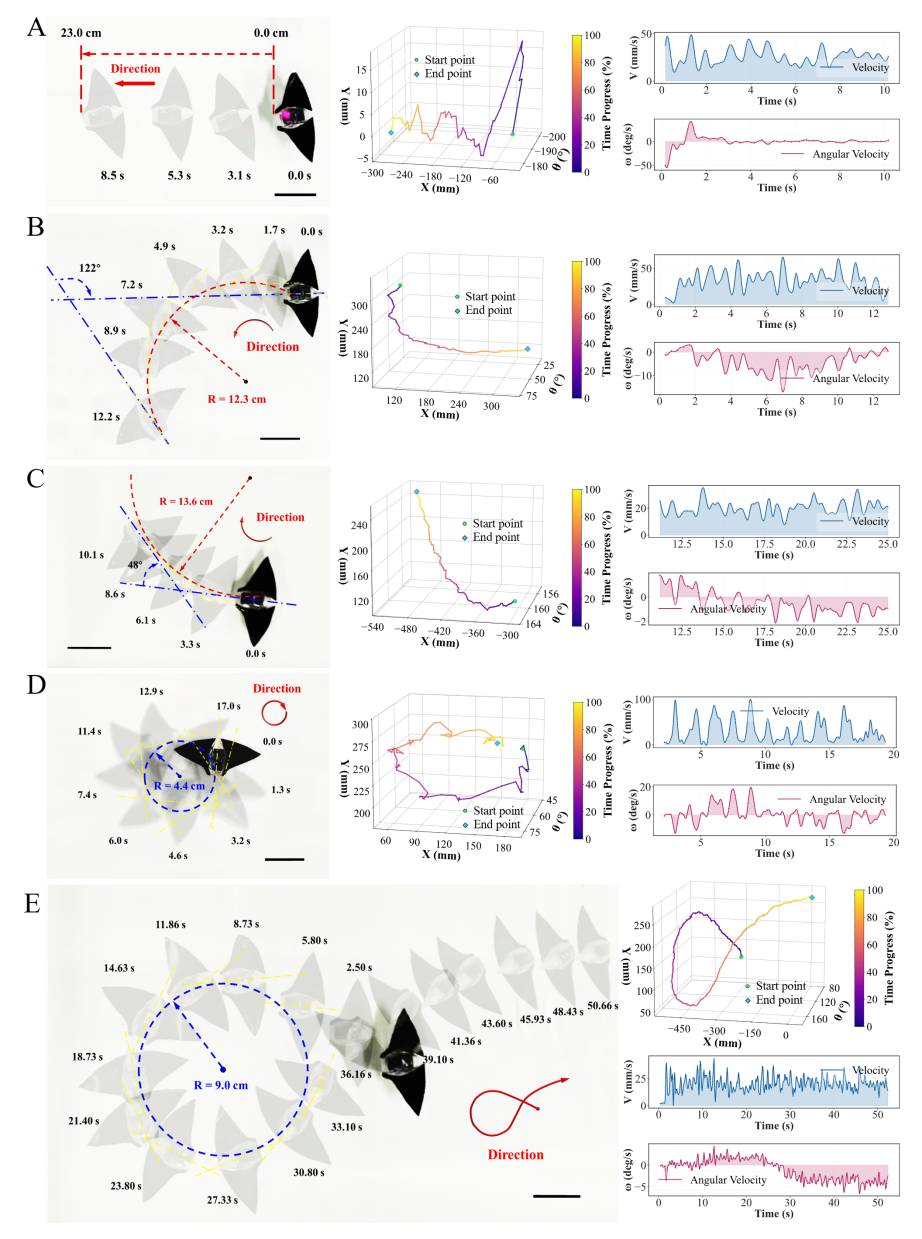
This study represents the first integration of natural, isolated skeletal muscle with a wireless optoelectronic neuromodulation system, validating the significant potential of natural, isolated skeletal muscle as a high-performance bioactuator. The system of muscle electrical stimulation parameters established in this study provides an experimental reference for the in vitro repair of neuromuscular injuries and dynamic tissue engineering culture platforms.


